In the current Canadian real estate landscape, the margin for error when listing a home has narrowed. As we navigate the mid-May spring market of 2026, buyers have become increasingly sophisticated and discerning. When you sit down with a real estate agent to prepare your listing, the conversation almost inevitably turns to the “emotional resonance” and the sophisticated neutrals that define your home. In a balanced market where inventory is stabilizing, homeowners can no longer rely on scarcity alone to drive multiple offers; they must rely on presentation.
The first thirty seconds of a showing are the most critical. Before a buyer even considers the age of the furnace or the square footage of the basement, they are reacting to the atmosphere. Often, sellers focus on big-ticket items while neglecting the visual “noise” that can clutter a buyer’s perception. Elements like outdated, heavy window coverings can darken a room and make it feel smaller, but the most pervasive influencer of mood is the colour of the walls. In 2026, the era of “flipper grey” is officially over, replaced by a palette that prioritizes warmth, wellness, and a sense of sanctuary.
The Quick Edit: Key Takeaways
- The ROI of Paint: A professional paint refresh remains the single highest-return investment for sellers, often yielding a 200% return on the cost of materials and labour.
- Warmth over Cold: Buyers are moving away from sterile, blue-toned whites and greys in favour of “organic” neutrals.
- Cohesion is King: Using a unified palette throughout the home creates a visual flow that makes smaller Canadian floor plans feel significantly larger.
The Rise of “Warm Minimalism”
Design trends in 2026 have shifted toward what experts call “Warm Minimalism.” This isn’t just about aesthetics. It is a response to the fast-paced, digital-heavy world we live in. Homeowners want their living spaces to feel like an “exhale.” This is where buyer psychology plays a massive role in the transaction. When a prospective buyer walks into a home painted in soft, earthy tones, their cortisol levels actually drop. They begin to envision themselves relaxing in the space, rather than tallying up a list of renovations they’ll need to perform.
For years, “Millennial Grey” was the default for staging because it was viewed as a safe, neutral ground. However, in the Canadian climate—where we spend a significant portion of the year under overcast skies—cold greys can feel gloomy and depressing. The transition to warm neutrals—think mushrooms, sandy beiges, and creamy ochres—brings a much-needed sense of “sunlight” into the home, even on a rainy Vancouver morning or a grey Toronto afternoon.
The 2026 Power Palette – 5 Shades That Sell
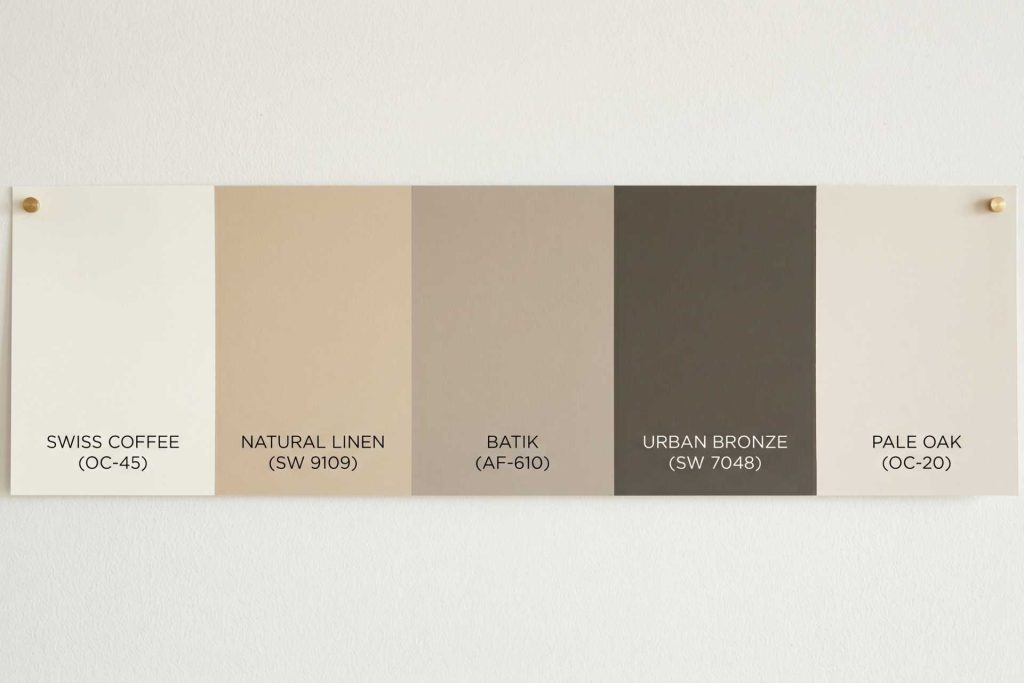
To maximize your home’s appeal, you need a palette that feels modern yet timeless. Here are the five shades currently dominating the Canadian market:
1. Swiss Coffee (OC-45 by Benjamin Moore)
This is the “Goldilocks” of whites. It isn’t too yellow, and it certainly isn’t blue. It is a creamy, frothy white that provides enough warmth to feel inviting but enough brightness to keep a room feeling airy. It is particularly effective in North-facing rooms where the light can often feel “flat.”
Why it works in 2026: In the Canadian housing market, “Swiss Coffee” has become the go-to for open-concept layouts because it acts as a visual bridge between different lighting conditions. Whether under the glow of LED pot lights or the greyish tint of a winter afternoon, it maintains its integrity without turning dingy. It provides a clean, gallery-like backdrop that allows a buyer’s colourful artwork or vibrant furniture to stand out, making the home feel sophisticated and ready for a magazine shoot.
2. Natural Linen (SW 9109 by Sherwin-Williams)
If you want your home to feel like a high-end boutique hotel, this is the shade. It mimics the look of unbleached flax and has a depth that makes white trim pop brilliantly. In 2026, this is a favourite for open-concept living areas because it provides a sophisticated backdrop for both modern and traditional furniture.
Why it works in 2026: This colour taps into the “Organic Modern” trend that is currently sweeping across the country. It pairs exceptionally well with natural textures like jute rugs, raw wood shelving, and stone fireplace surrounds. By using “Natural Linen,” you are signalling to the buyer that the home is a premium, curated space. It feels more expensive than a standard white, suggesting a level of luxury and custom design that justifies a higher asking price.
3. Batik (AF-610 by Benjamin Moore)
For sellers who are nervous about moving too far away from grey, Batik is the perfect “bridge” colour. It is a refined greige with a heavy leaning toward taupe. It feels grounded and expensive. It is an excellent choice for primary bedrooms where you want to create a sense of cozy luxury.
Why it works in 2026: “Batik” is essentially the “adult” version of the greys that dominated the last decade. It offers a sense of architectural structure to a room, making it feel solid and well-built. In a primary suite, this colour creates a “cocoon” effect that appeals to the buyer’s need for a private retreat. It hides minor wall imperfections beautifully and looks stunning when paired with crisp white linens and warm brass fixtures—a combination that is currently very high on the list of finishes that buyers like.
4. Urban Bronze (SW 7048 by Sherwin-Williams)
While you shouldn’t paint a whole room in this deep, warm charcoal, it is the ultimate “grounding” colour for 2026. Real estate pros are seeing huge success using this on kitchen islands, front doors, or even fireplace mantels. It provides the necessary contrast that makes the lighter neutrals around it look even fresher.
Why it works in 2026: In a sea of light neutrals, “Urban Bronze” provides the visual “weight” needed to define a space. For example, painting an old oak kitchen island in this shade can instantly modernize the entire room for the cost of a single gallon of paint. It feels earthy and rooted in nature, avoiding the coldness of a true black. It’s a strategic choice that adds a “designer touch” to a home, making it memorable among the dozens of properties a buyer might see in a single weekend.
5. Pale Oak (OC-20 by Benjamin Moore)
This is often called the “chameleon” colour. In bright light, it looks like an elegant, off-white; in shadows, it develops a beautiful, soft tan depth. It is incredibly versatile and works well with the light oak flooring that is currently one of the finishes that buyers like most in new Canadian developments.
Why it works in 2026: The beauty of “Pale Oak” lies in its subtle complexity. It is the ultimate choice for a “whole-house” colour because it adapts to every room’s unique orientation. It never feels heavy or overwhelming, making it ideal for smaller condos or bungalows where maximizing the perception of space is a priority. It creates a seamless flow from the entryway to the bedrooms, reducing visual “stops” and making the entire floor plan feel expansive and unified—exactly what a buyer is looking for in a move-in-ready property.
Why Paint Beats a Kitchen Reno in 2026
One of the biggest mistakes sellers make is over-renovating. In a balanced market, the “clean slate” approach is often more profitable. While a $50,000 kitchen renovation might seem like a good idea, there is always the risk that the buyer won’t like your choice of backsplash or countertop. However, it is a well-known industry fact that a fresh coat of paint boosts the value of the house more consistently than almost any other upgrade.
Paint hides the “sins” of a lived-in home—the scuffs on the baseboards, the faded patches from old picture frames, and the lingering odours of daily life. By presenting a pristine, neutral environment, you are selling a “possibility.” You are giving the buyer a blank canvas where they can project their own lives. In 2026, with the cost of labour and materials remaining high, a “turn-key” look is a massive competitive advantage.
Avoiding the “Turn-Off” Traps
Understanding what to avoid is just as important as knowing what to include. Bright, saturated colours—like a deep red dining room or a lime green nursery—are statistically proven to be the thing that puts the homebuyers off the most. Most buyers lack the imagination to see past a bold colour choice. All they see is a “to-do” list and a weekend spent with a roller and a ladder.
Similarly, neglect in the small details can signal larger structural issues to a cautious buyer. If the paint is peeling or the caulking around the windows is cracked, a buyer might wonder if the roof or the foundation has also been neglected. Presentation is a proxy for maintenance. A home that looks cared for on the surface suggests a home that has been cared for in the bones.
The Affordability Factor
We cannot discuss the 2026 market without mentioning affordability. With interest rates having stabilized at 2.25%, buyers are no longer in a frantic rush, but they are still extremely budget-conscious. They want to know that their “all-in” cost is predictable. A home that is freshly painted in modern neutrals suggests that no immediate cosmetic work is required.
This “move-in ready” status allows buyers to put their minimum down payment toward the house itself, rather than holding back $20,000 for immediate renovations. When a home is staged correctly, it feels like a finished product, which justifies a higher asking price and often leads to an appraisal that supports the sale.
Setting the Stage for a Premium Sale
Selling a home in Canada in 2026 is an exercise in strategic positioning. You are not just selling four walls and a roof; you are selling a lifestyle. By embracing the shift toward warm neutrals, you are tapping into the current psychological needs of the market—stability, warmth, and simplicity.
Don’t let a dated colour palette hold back your home’s potential. Before you list, take the time to declutter, remove those heavy drapes, and invest in high-quality, warm neutral paint. It is the fastest, most effective way to transform your property from a “house for sale” into a “dream home.” When you create an environment where a buyer can walk in, take a deep breath, and say, “I’m home,” you’ve already won half the battle.